
What Safe Havens Mean in an Uncertain World
For years, investors have relied on a familiar playbook: when markets turn volatile, move into “safe” assets. But that playbook is starting to break down. As bonds, gold and even other defensive assets behave less predictably, protecting wealth today requires a more thoughtful, strategy-driven approach.
In recent times, uncertainty has almost become a certainty. Volatility is to be expected, and with the pace of information and technology, that upheaval can ripple through the global economy faster than you can say “volatility”.
When markets become uncertain, investors instinctively turn to “safe haven” assets. These are what we’ve always known to be reliable and lower risk. The idea of safe haven investing was pretty straightforward.
When riskier assets fell, you moved to:
- Government bonds – which tend to move in the opposite direction of equities
- Gold – as a hedge against uncertainty
- Cash – to preserve capital
For a long time, they worked. But now, we’re looking at a very different picture, and our old coping mechanisms no longer work. This shift isn’t theoretical – it has already happened.
Back in 2022, global equities fell sharply, but that wasn’t the surprise. The surprise was that bonds fell, too, at almost the same pace. This was one of the rare periods in modern history where the traditional bond-stock relationship broke down, throwing one of the most widely used portfolio strategies out the window.
This raises a very uncomfortable question: what does “safe” mean today?
What we’re dealing with today
Today’s market environment is very different. We’re no longer dealing with a single dominant risk, but multiple forces interacting at once.
- Inflation is back
Inflation is the big bad monster we always try to outpace. It doesn’t just affect grocery prices; it erodes real returns. This is particularly damaging for bonds as fixed income loses purchasing power. For cash, its real value declines over time. RM100 today doesn’t get you much and will buy you even less 10 years from now.
Even gold1, which was commonly thought of as the best inflation hedge, remained quiet during the 2022 inflation spike. It merely held its value instead of surging due to rising interest rates and a stronger dollar. - Interest rates are higher—and more volatile
Bonds used to be the hallmark of reliability and sensibility. Bonds were your parents’ idea of a graduation gift. Higher rates have made bonds more fragile.
At the same time, the relationship between stocks and bonds has shifted dramatically2:
• Before 2020: negatively correlated ~60% of the time
• After 2020: less than 10% of the time
That’s a fundamental regime change. - Risks are more complex and overlapping
Safe haven assets no longer react to one risk, but several at once. Markets today are dealing with multiple layers of uncertainty:
• Geopolitical tensions
• Energy price shocks
• Policy shifts
As a painful example, let’s look at how recent geopolitical tensions have pushed oil prices sharply higher, at one point surging nearly 60% in a month. This raised inflation concerns, affecting both equity and bond markets simultaneously.
Understanding what “safety” really means
Here’s the hard truth: “Safe” does not mean “risk-free”. Every asset carries its own risk and limitations. These trade-offs matter more in today’s environment.
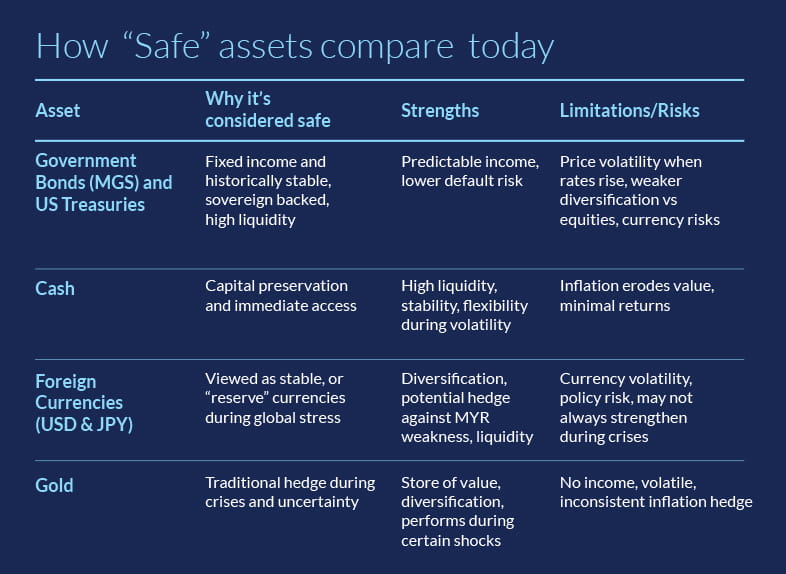
Then there’s timing risk in entering safe assets too late, after prices have already moved.
A more practical approach
We need to change our idea of safety so we can rethink our approach. Instead of relying on specific assets, investors are shifting towards strategy-led protection.
How it works:
- Diversify your sources of protection
No single asset works in every environment. - Include real assets
Commodities, infrastructure, and inflation-sensitive assets can provide alternative protection. - Focus on portfolio construction
Balance across:
• Growth
• Income
• Stability
And think in terms of scenarios, not predictions. There is no magic crystal ball. - Maintain liquidity
Liquidity matters more in volatile environments. - Stay dynamic and agile
Static portfolios struggle in dynamic markets.
Where safety and protection really start
There’s another shift happening that many overlook. Before investing for growth, many investors are now focusing on protecting what they already have.
This protection includes:
• Life insurance3 or Takaful4
• Income protection
• Legacy planning
These solutions are increasingly positioned as part of a broader wealth strategy. Protection is no longer viewed as a feature of specific investments, but as an outcome of thoughtful portfolio construction.
More experienced investors are already adjusting to this new reality. Rather than relying heavily on traditional bonds as their primary source of stability, they are diversifying more broadly across asset classes, including real assets and alternative investments that can respond differently to changing conditions.
There is also a stronger emphasis on capital preservation and downside protection, not just return generation. In practice, this means building portfolios that are resilient across multiple scenarios (not predictions!) rather than depending on a single asset, like property, for example, to offset risk.
The thinking is shifting from: “What is safe?” to “What can actually protect me in different conditions?”
What this means for you
Take a step back and ask:
- Is my portfolio overly dependent on EPF or property?
- How did my “safe” assets perform recently?
- Do I have protection against inflation, and not just volatility?
- Can I access liquidity when I need it?
These are the questions that determine how resilient your portfolio will be in the face of change.
In today’s market, safety is no longer about choosing the “right” asset. It’s about building a portfolio that can handle multiple outcomes, because true protection doesn’t come from EPF, bonds, gold, or property alone. It comes from how everything works together.
Get in touch with your Relationship Manager to discuss how you can build a resilient portfolio.
References:
- Baronyan, S. R., & Nae, A. (2025, April). Gold in a fragmented world: Safe haven and strategic asset. FTSE Russell.
- Wang, T. (2025, January 13). Navigating a brave new world of bond investing. Reuters.
- RHB Group. (n.d.). Legacy life insurance. RHB Group.
- RHB Group. (n.d.). mySmart Invest. RHB Group.