

Cut Through the Noise: Top 6 Malaysian Equity Themes to Watch in 2026
This year, Malaysian markets will be shaped by these key themes. Understanding them can help you build portfolios with greater clarity and conviction.
In a world where news and information are almost instantaneous, it’s easy to get caught up in stock tips and daily market headlines. But here’s what you need to know about markets: they are rarely moved by a single company in isolation. They are shaped by trends, policies, and shifts in how economies operate.
Successful investing is not about betting on the right stock. It’s about understanding the environment in which that stock operates. Markets reward investors who can identify long-term trends early and remain patient as they play out.
In 2026, Malaysia’s equity market is being influenced by a clear set of themes, from infrastructure development and technology demand to digitalisation and consumer spending. However, escalating geopolitical tensions and the risk of prolonged supply disruptions, particularly in key global shipping routes, are introducing new uncertainties, with potential implications for trade flows, operating costs and overall economic growth.
Ask yourself, what broader forces are shaping the market in the first place? By recognising these broader forces, you can reduce guesswork, stay grounded during market volatility and make more informed decisions aligned with your goals and risk profile.
To get you started, these are six Malaysian equity themes worth paying attention to in 2026:
- Infrastructure: When government spending leads the way
- Semiconductors: Malaysia’s role in a tech-driven world
- Tourism and consumption: Getting back into spending
- Utilities: Boring, but essential
- Digital economy: A structural shift
- Energy: Riding the oil price cycle
Why it matters
Infrastructure remains a core pillar of Malaysia’s economic strategy. Large-scale projects tend to run over multiple years, offering earnings visibility to companies involved, even during periods of global uncertainty.
This is further supported by the country’s strengthening economic momentum. Malaysia recorded GDP growth of 5.2% in Q3 2025, the fastest in a year, with advance estimates pointing to a stronger 5.7% growth in Q4 2025. Expansion across key sectors, including services, manufacturing, construction and agriculture, signals a broad-based recovery, reinforcing the case for continued infrastructure spending as a driver of sustained growth.
However, the outlook remains subject to external risks. Prolonged geopolitical tensions, elevated energy prices and potential supply chain disruptions could weigh on global growth and trade flows, which in turn may affect Malaysia’s export performance and overall economic trajectory.
Who stands to benefit
Construction and engineering players, building material suppliers, and transport or utility-related operators often sit at the centre of this theme.
What investors should know
Infrastructure stocks are typically cyclical and may not deliver rapid price spikes. The appeal lies in steady, long-term growth, making this theme more suitable for patient investors than short-term traders.
Why it matters
Malaysia continues to play a critical role in the global semiconductor supply chain, particularly in assembly, testing and support services. Demand remains supported by long-term trends such as artificial intelligence, electric vehicles and data centres.
This is reinforced by strong investment momentum. In the first nine months of 2025, approved investments rose 13.2% year-on-year to RM285.2 billion, with foreign investments making up 52.9% (RM150.8 billion), a sharp 47.5% increase. Growth has been led by services, particularly data centre-related activities, while manufacturing, closely linked to semiconductors, accounted for RM93.8 billion (32.9%).
Sustained inflows from key partners such as Singapore, China and Japan further underscore Malaysia’s role in global supply chains and digital infrastructure development.
Who stands to benefit
Semiconductor manufacturing services, precision engineering firms and industrial automation providers are key beneficiaries, with spillover effects into construction and selected consumer segments as supporting ecosystems expand.
What investors should know
This sector can be volatile, moving in line with global tech cycles. Earnings may fluctuate year to year, so it suits investors with a medium- to long-term horizon who can tolerate short-term swings.
Why it matters
Tourism has largely recovered, providing a lift to hospitality, transport and retail sectors. At the same time, improving consumer confidence supports domestic spending, which is a major engine of Malaysia’s economy.
As of July 2025, Malaysia recorded 24.5 million international arrivals, up 16.8% year-on-year, with China leading the rebound at a strong 35.6% increase.
Stronger tourism activity is expected to boost visitor spending, while resilient domestic consumption continues to anchor economic growth, helping cushion against external uncertainties. This momentum is further supported by the government’s Visit Malaysia 2026 campaign, which targets 35.6 million visitors and RM147.1 billion in tourism receipts.
Who stands to benefit
Airports, transport operators, hotels and leisure businesses stand to gain, alongside consumer discretionary names (think non-essentials like apparel and leisure), and retail REITs.
What investors should know
Tourism-linked stocks are sensitive to external factors such as currency movements, geopolitical tensions, and global economic conditions.
Sustained high oil prices and potential supply disruptions could reduce disposable income globally, weighing on discretionary spending and travel demand. This may also affect the pace of recovery under Visit Malaysia 2026 if geopolitical tensions persist.
At the same time, stronger domestic consumption continues to provide a buffer, making this theme best approached as part of a diversified portfolio rather than a standalone bet.
Why it matters
Electricity, water and essential services are needed regardless of economic cycles. Utilities often offer predictable cash flows and consistent dividends, making them attractive during volatile periods.
Who stands to benefit
Power generation and distribution companies, renewable-linked utilities and water service providers.
What investors should know
Utilities are generally lower-growth but more defensive. While share prices may move slowly, dividends can provide steady income, making them appealing to conservative or income-focused investors.
Why it matters
Digitalisation is no longer optional. Malaysia continues to push forward in areas such as digital payments, cloud services, e-commerce and data infrastructure. A weaker ringgit also provides a near-term boost to export-oriented sectors such as technology, electrical and electronics (E&E), gloves and plantations, supporting earnings for companies tied to global demand.
Who stands to benefit
Telecommunications providers, data centre operators and technology service companies.
What investors should know
Some digital stocks prioritise growth over profitability, especially in earlier stages. Valuation discipline matters. Patience and selectivity are key when approaching this theme.
Why it matters
Energy markets have come back into focus amid rising geopolitical tensions in the Middle East. The ongoing conflict involving the US, Israel and Iran has disrupted global supply flows, pushing oil prices above US$100 per barrel and introducing a sustained risk premium into energy markets.
For Malaysia, this creates a mixed but generally supportive backdrop. As a hydrocarbon producer, the country stands to benefit from firmer crude prices, with national oil company PETRONAS potentially seeing stronger upstream earnings and higher contributions to government revenue.
Who stands to benefit
Oil and gas producers, upstream service providers and energy-linked contractors are key beneficiaries. Higher activity levels may also support related segments such as offshore services and energy infrastructure.
What investors should know
Energy is highly cyclical and closely tied to global oil prices. While higher prices can boost revenues, they also increase costs across the value chain and can introduce broader economic pressures. Sustained high oil prices may strain Malaysia’s fiscal position, as higher oil-related revenues are partly offset by increased fuel subsidy costs. This could limit fiscal space for development spending and lead to reprioritisation of government expenditure over time.
This means the upside is real. But so is the volatility. Investors should approach the sector tactically, rather than treating it as a long-term defensive play.
How to position yourself
Rather than going all out and betting on a single theme, a smarter move is to mix themes based on your own goals. Your goals and risk profile are less likely to change as often – or as drastically – as the markets.
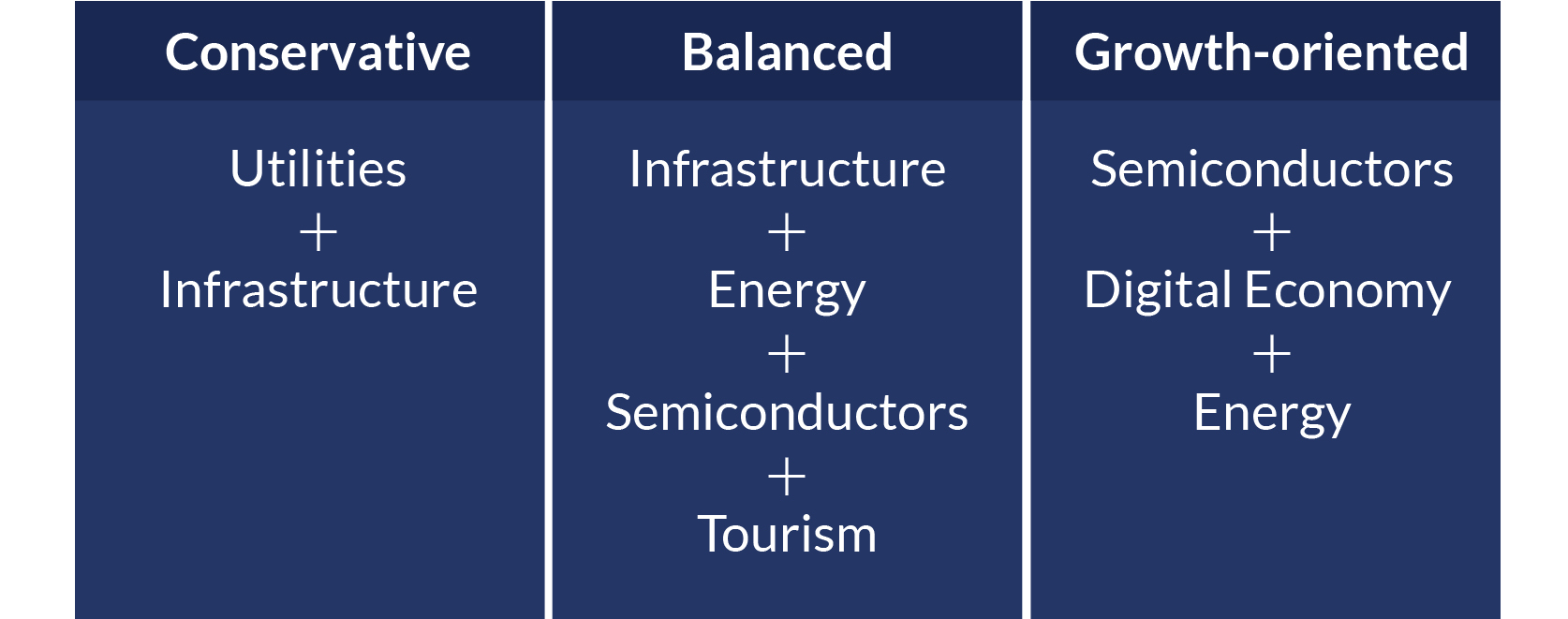
Besides crafting a carefully curated basket of stocks, you can gain exposure to the various themes through a mix of unit trusts or exchange traded funds (ETFs). The latter two are lower effort, while curating your own basket of stocks offers a more hands-on approach.
For investors seeking broad exposure to the Malaysian market, funds such as the RHB Dana Islam (Equity Fund) and RHB Mudharabah (Mixed Asset Fund) provide diversified access across sectors, helping to capture multiple themes within a single investment.
Bear in mind that no theme is risk-free. Global slowdowns, sector rotation and policy changes can all affect performance. Past performance is not a guarantee of future returns. That is why the core of your approach should always be diversification and alignment with your own risk tolerance and goals.
The takeaway
It’s impossible to predict the market’s next move, but if you understand the forces shaping it, you’ll be better prepared for what lies ahead. Speak to your Relationship Manager today to discuss your approach to equities in 2026.

Disclaimer:
This article has been prepared by RHB and is solely for your information. This article is strictly private, confidential and personal to its recipients and should not be copied, distributed or reproduced in whole or in part, nor passed to any third party, without obtaining prior permission of RHB Bank Sdn Bhd (“RHB”). In preparing this presentation, RHB has relied upon and assumed the accuracy and completeness of all information available from public sources or which was otherwise reviewed by RHB. Accordingly, whilst we have taken all reasonable care to ensure that the information contained in this presentation is not untrue or misleading at the time of publication, we cannot guarantee its accuracy or completeness and make no representation or warranty (whether expressed or implied) and accept no responsibility or liability for its accuracy or completeness. You should not act on the information contained in this article without first independently verifying its contents.
Any opinion, management forecast or estimate contained in this article is based on information available as at the date of this article and are subject to change without notice. It does not constitute an offer or solicitation to deal in units of any RHB fund and does not have regard to the specific investment objectives, financial situation or the particular needs of any specific person who may receive this. Investors may wish to seek advice from a financial adviser/unit trust consultant before purchasing units of any funds. In the event that the investor chooses not to seek advice from a financial adviser/unit trust consultant, he should consider whether the fund in question is suitable for him. Past performance of the fund or the manager, and any economic and market trends or forecast, are not necessarily indicative of the future or likely performance of the fund or the manager. Investors are advised to read and understand the content of the relevant documents including but not limited to the prospectus or information memorandum that has been registered with the Securities Commission and Product Highlight Sheet before investing. Investors should also consider all fees and charges involved before investing. Prices of units and income distribution, if any, may go down as well as up; where past performance is not a guarantee of future performance. Units will be issued upon receipt of the registration form referred to and accompanying the Prospectus. The printed copy of the prospectus and Product Highlight Sheet is available at RHB branches/Premier Centres and investors have the right to request for a Product Highlight Sheet.
A Product Highlights Sheet (“PHS”) highlighting the key features and risks of the RHB Dana Islam Fund dated 26 October 2001, and RHB Mudharabah Fund dated 9 May 1996 are available and investors have the right to request for a PHS.
The Manager wishes to highlight the specific risks of the Dana Islam Fund which are Market Risk, Particular Securities Risk, Currency Risk, and Country Risk. The specific risks of RHB Mudharabah Fund are Stock Market Risk, Individual Stock Risk, Liquidity Risk, Issuer Risk, Interest Rate Risk, Credit and Default Risk, and Shariah Specific Risk and other general risks are elaborated in the Information Memorandum.
This article has not been reviewed by the Securities Commission Malaysia (SC).
RHB Bank Berhad 196501000373 (6171-M) | RHB Islamic Bank Berhad 200501003283 (680329-V)