

Staying selective in uncertainty: Positioning for Q2 2026
In our quarterly Fund Discovery series, we delve into current market conditions and provide insights and strategies to diversify your portfolio.
Listen and subscribe to the podcast hosted by RHB Bank’s Head of Investor Advisory, Nova Lui, to stay updated on the latest market developments.
The first quarter of 2026 was a clear reminder that markets rarely move in a straight line. Early optimism surrounding AI and hardware spending lifted selected equity markets, particularly in North Asia. We saw the KOSPI gain 12.5%, and Taiwan’s FTSE rise 8.5%.
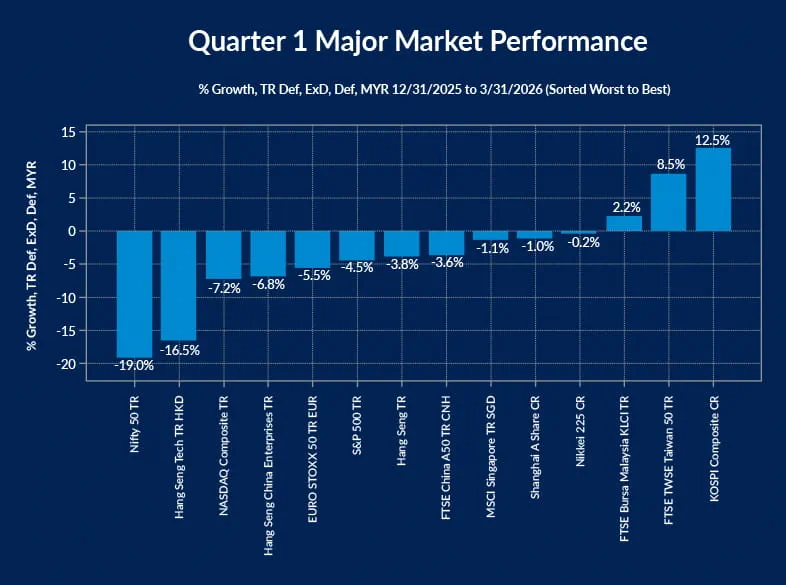
Source: Lipper Investment Management as of 31 March 2026.
Later in the quarter, renewed geopolitical tensions and rising oil prices triggered a sharp shift towards safer assets. Escalating US-Iran tensions pushed crude oil prices above the USD100 mark, triggering a sharp retraction in investor sentiment. Markets that relied heavily on imported energy were hit hardest, with India’s Nifty 50 falling 19%.
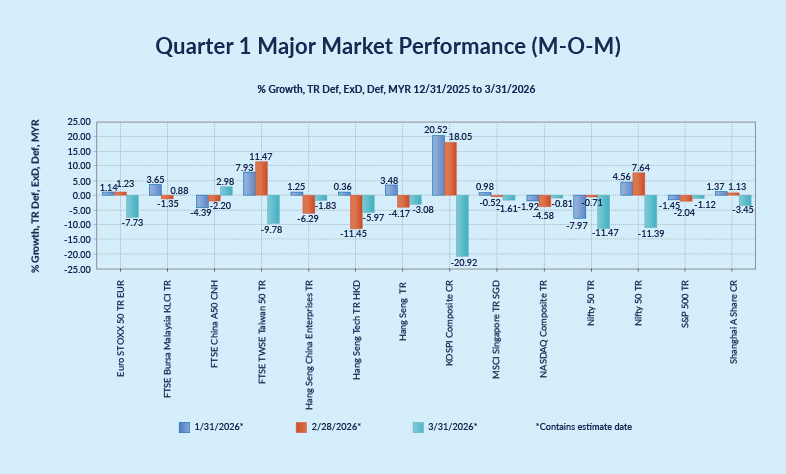
Source: Lipper Investment Management as of 31 March 2026.
For investors, this shaky backdrop raises an important question: do you stay defensive, or stay invested?
The answer lies somewhere in between. Markets are no longer binary, so why should your approach be? Rather than choosing one or the other, you could stay invested — selectively. That means focusing on quality growth opportunities, dependable income streams, and diversification across regions and asset classes.
Review of our Q1 strategy
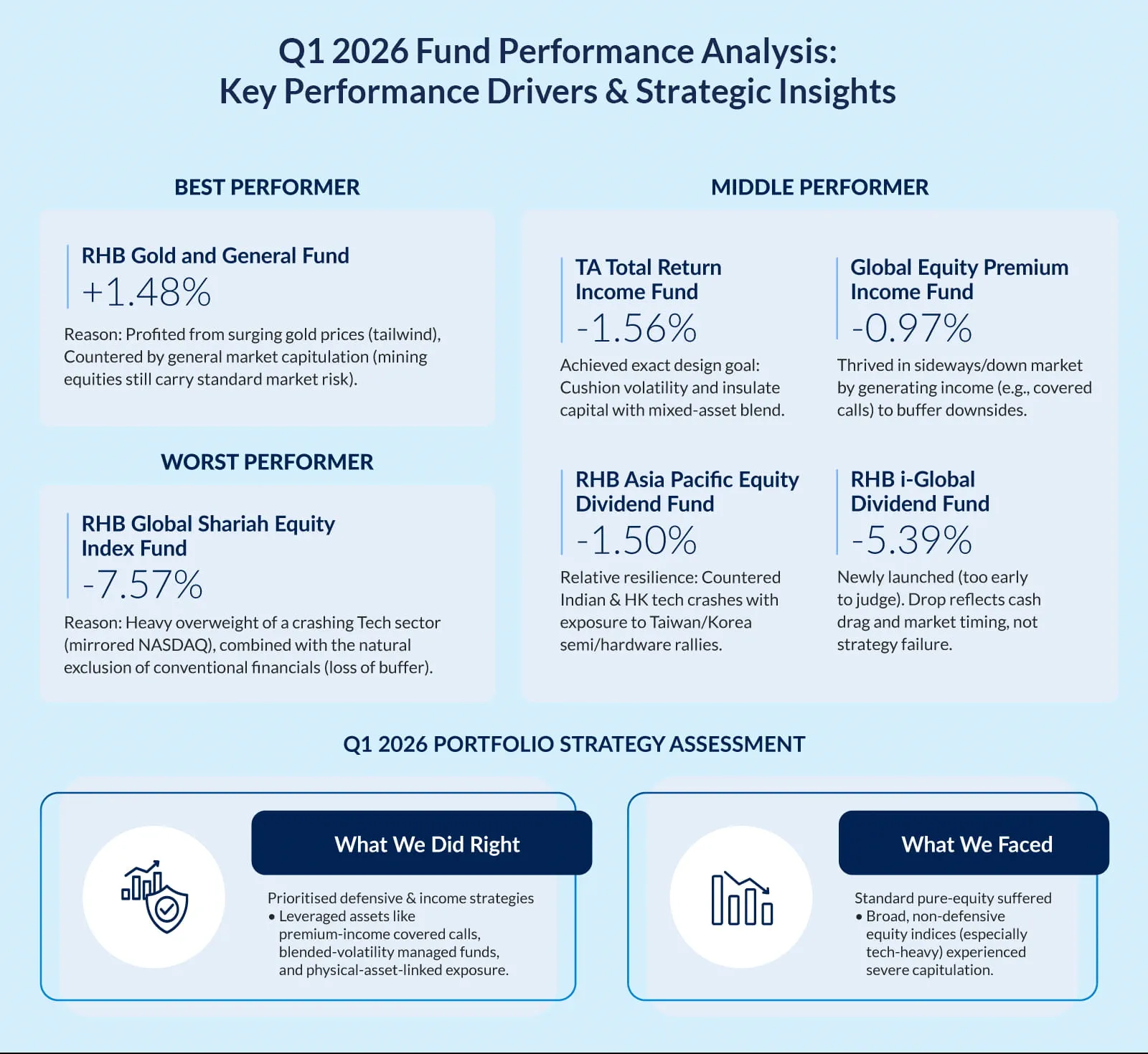
Source: Lipper Investment Management as of 31 March 2026.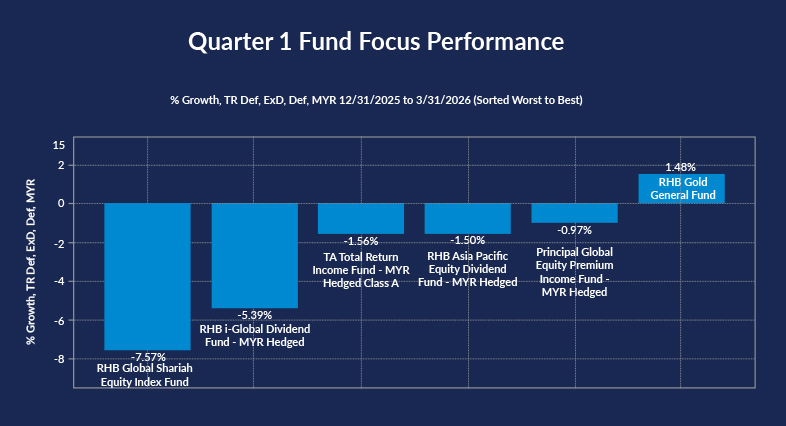
Source: Lipper Investment Management as of 31 March 2026.
Looking back at our Q1 portfolios, our shift towards defensive and income-focused strategies proved effective. The strongest performer was the RHB Gold and General Fund, which gained 1.48%, supported by rising gold prices. Our mixed-asset and premium-income selections, such as the TA Total Return Income Fund and RHB Global Equity Premium Income Fund, performed as intended by helping to cushion volatility during the March market selloff.
On the other hand, the RHB Global Shariah Equity Index Fund declined 7.57%. This was mainly due to its higher exposure to the technology sector during the correction.
Why holding too much cash can be risky…and what you should do instead
Holding cash can feel comfortable during uncertain periods. It offers liquidity, flexibility, and peace of mind. However, when inflation remains elevated and interest rates may eventually trend lower, excessive cash positions can quietly erode purchasing power over time.
This does not mean avoiding cash entirely. Emergency reserves and short-term liquidity remain important. But for medium- to long-term investors, remaining overly defensive can result in opportunity costs if markets recover while capital sits idle.
In other words, market volatility is risky, but sitting on the sidelines will cost you in other ways.
In an environment where growth remains resilient, many global investors continue to favour staying invested, with a focus on quality assets and reliable income. Holding excessive cash is increasingly seen as less attractive, given the opportunity cost in an inflationary environment.
It’s now a matter of quality and yield over idle cash.
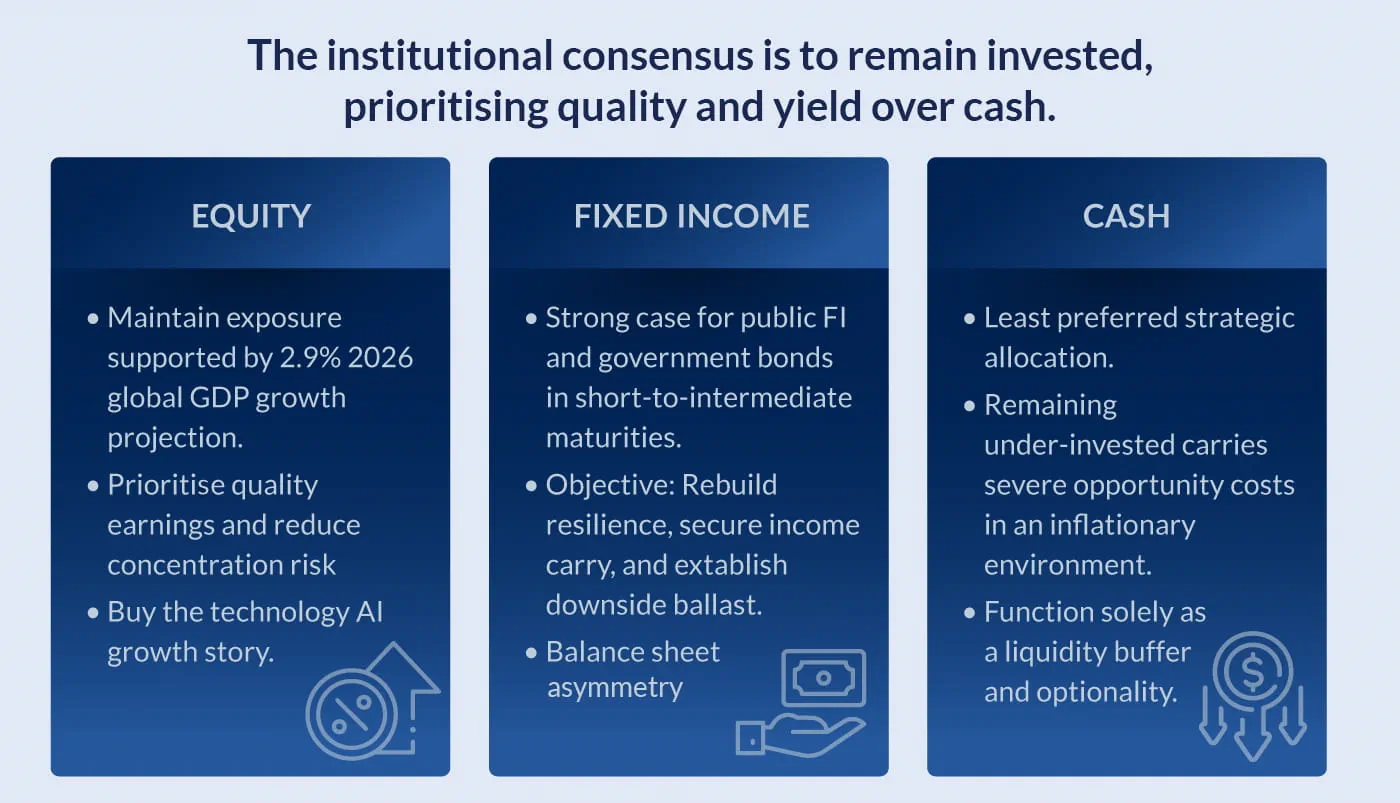
Source: RHB Bank Q2 2026.
The 3 core themes for Q2 2026
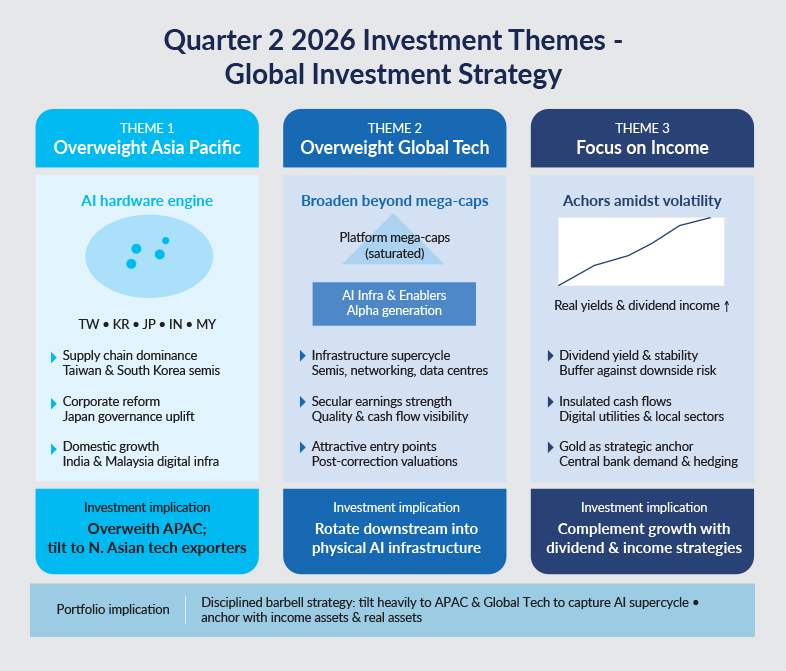
Source: RHB Bank Investors Advisory, Q2 Quarterly Investment Insight, 7 April 2026.
For Q2 2026, investors may consider a disciplined “barbell” strategy built around three core themes:
- Asia’s AI Advantage
Asia continues to play a key role in global growth, particularly through semiconductor and AI supply chains led by Taiwan and South Korea, alongside Japan’s corporate reforms and Southeast Asia’s domestic growth story.
For investors seeking regional exposure with income potential, the RHB Asia Equity High Income Fund offers access to Asian markets through a dividend-focused strategy with long-term growth potential. - Beyond Big Tech
Technology remains a powerful long-term theme, but opportunities are expanding beyond the largest tech companies into areas such as semiconductors, networking, cloud infrastructure, and industrial automation.
The RHB Global Focused Growth Equity Fund provides exposure to companies benefiting from structural growth trends, while the Principal Nasdaq Equity Premium Income Fund combines technology exposure with an income-generating options strategy. - Income as a Stabiliser
In uncertain markets, income-generating assets can help cushion volatility and provide more consistent returns. Dividend strategies, premium-income funds, and fixed income remain important portfolio anchors.
Funds such as the RHB Global Equity Premium Income Fund and TA Total Return Income Fund focus on generating regular income while maintaining diversified exposure.
A smarter way to build a portfolio
Rather than concentrating on one theme, you may consider a core-satellite strategy.
Core holdings - The core portion of a portfolio can focus on resilience, diversification, and income. This may include fixed income, dividend strategies, or balanced funds.
Satellite holdings - Satellite allocations can be used for higher-growth ideas such as global innovation, technology, or Asia’s structural expansion.
This approach can help investors remain invested while balancing opportunity and risk. While the core prioritises stability and broad diversification to secure income and act as a cushion, your satellites should be tactical, high-potential plays that are quick and agile enough to capture the next wave of growth and innovation.
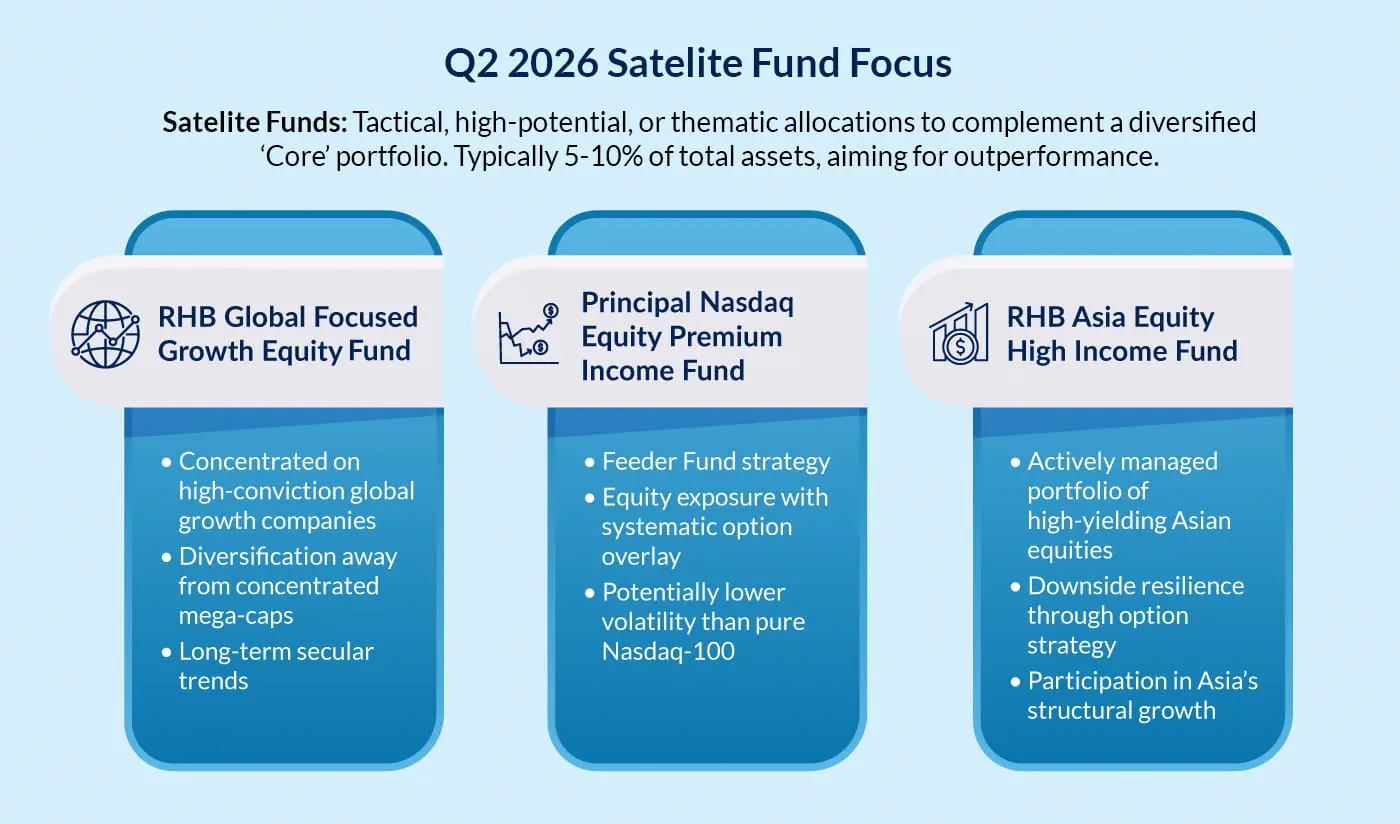
Source: RHB Bank Q2 2026.
Satellite 1: Global Growth & Innovation
For investors seeking exposure to the next wave of global innovation, the RHB Global Focused Growth Equity Fund offers a flexible, high-conviction strategy managed by T. Rowe Price. Unlike benchmark-driven funds, it can invest across both developed and emerging markets, allowing managers to pursue opportunities wherever they emerge.
The portfolio typically holds a concentrated list of quality growth companies with strong fundamentals, improving returns, and durable competitive advantages. Key themes may include artificial intelligence, automation, digital transformation, healthcare innovation, and the green transition.
This may suit investors looking for long-term capital growth and a more active approach to global equities.
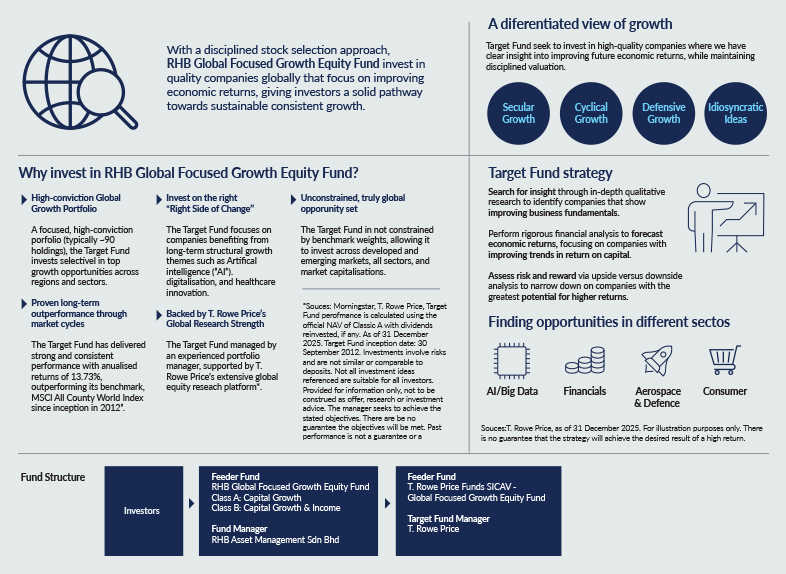
Source: RHB Global Focused Growth Equity Fund’s Placemat as of January 2026.
Satellite 2: Technology Exposure with Monthly Income
For investors who remain constructive on technology but prefer a more income-oriented strategy, the Principal Nasdaq Equity Premium Income Fund combines exposure to Nasdaq-related equities with an options overlay strategy.
The fund invests in leading technology and growth companies while selling covered call options to generate premium income, with targeted annual income distribution in the region of 8% to 10% (subject to market conditions). This approach may help smooth volatility compared with holding technology equities outright.
It can appeal to investors who want participation in the technology sector while also prioritising regular cash flow.
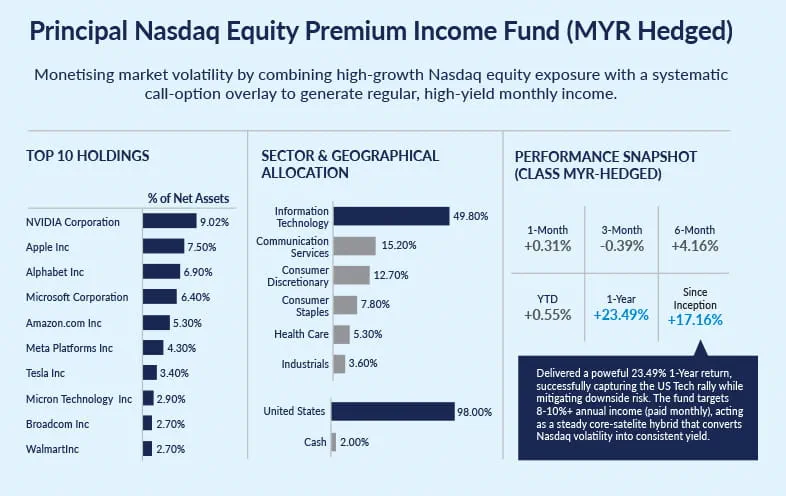
Source: Fund Fact Sheets of Principal Nasdaq Equity Premium Income Fund as of February 2026.
Satellite 3: Asia Growth with Income Potential
For investors seeking to capture Asia’s long-term growth story while maintaining an income focus, the RHB Asia Equity High Income Fund provides diversified exposure across Asia ex-Japan markets.
The strategy focuses on dividend-paying companies with sustainable earnings and payout potential, while also using options strategies to enhance yield and reduce downside volatility. Current sector exposure includes technology and financials, giving investors access to both Asia’s semiconductor supply chain and domestic banking growth.
With allocations across markets such as Greater China, Taiwan, South Korea and India, the fund may suit investors who want regional growth supported by income generation.
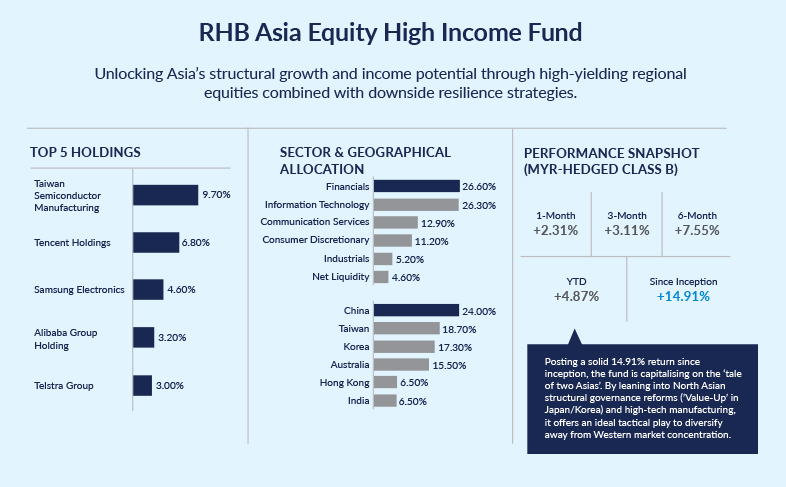
Source: Fund Fact Sheets of RHB Asia Equity High Income fund as of February 2026.
Use the stronger Ringgit to your advantage
For Malaysian investors, currency trends also matter. A stronger ringgit may improve purchasing power when allocating into foreign assets, creating opportunities for geographic diversification. Think of it as diversification in two dimensions at once: you're broadening your asset class exposure and your currency exposure in a single move. It’s worth mentioning USD-denominated foreign bonds are here for their liquidity.
These are some bond ideas that are worth considering:
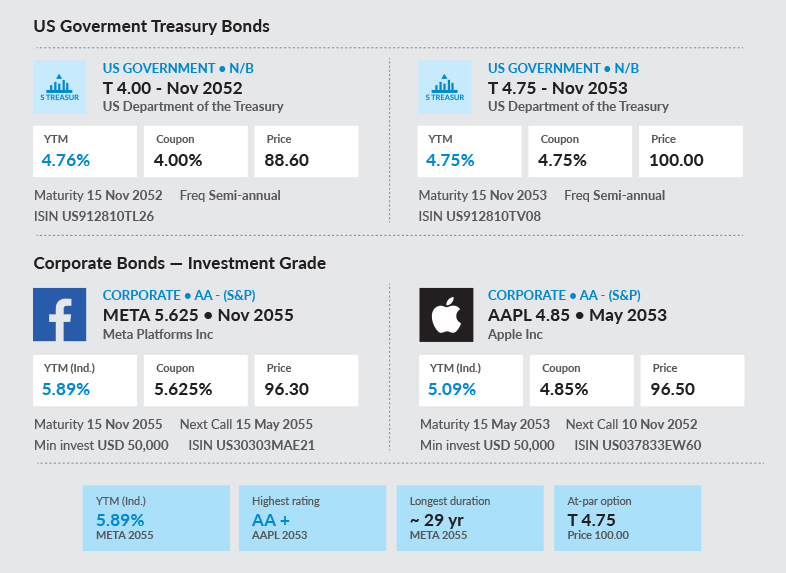
Source: Bloomberg as of 6 April 2026.
The real cost of waiting
Markets will always present reasons to delay investing. Elections, inflation, conflict, recession fears, and policy uncertainty are permanent features of the investing landscape. Yet, long-term wealth is often built not by waiting for perfect clarity, but by staying consistently invested through imperfect conditions. The perfect time is always now.
The key message for Q2 is to avoid holding too much cash, as it may mean missing investment opportunities. Use market volatility to gradually put money to work. Look beyond the biggest technology names, consider Asia’s semiconductor growth story, and balance your portfolio with premium income funds and gold to help manage geopolitical uncertainty.
We hope this gives you some inspiration in building a solid portfolio. Get in touch with your Relationship Manager to discuss how you can implement these ideas.

Terms & Conditions apply
Disclaimer:
This article is strictly for its intended recipients and should not be copied, distributed or reproduced in whole or in part, nor passed to any third party, without obtaining prior permission of RHB Bank Berhad (“RHB”).
This article has been prepared by RHB and is solely for your information only. It may not be copied, published, circulated, reproduced, or distributed in whole or part to any person without the prior written consent of RHB. In preparing this presentation, RHB has relied upon and assumed the accuracy and completeness of all information available from public sources or which was otherwise reviewed by RHB. Accordingly, whilst we have taken all reasonable care to ensure that the information contained in this presentation is not untrue or misleading at the time of publication, we cannot guarantee its accuracy or completeness and make no representation or warranty (whether expressed or implied) and accept no responsibility or liability for its accuracy or completeness. You should not act on the information contained in this podcast without first independently verifying its contents.
Any opinion, management forecast or estimate contained in this article is based on information available as of the date of this article and is subject to change without notice. It does not constitute an offer or solicitation to deal in units of any RHB fund and does not have regard to the specific investment objectives, financial situation or the particular needs of any specific person who may receive this. Investors may wish to seek advice from a financial adviser/unit trust consultant before purchasing units of any funds. In the event that the investor chooses not to seek advice from a financial adviser/unit trust consultant, he should consider whether the fund in question is suitable for him. Past performance of the fund or the manager, and any economic and market trends or forecast, are not necessarily indicative of the future or likely performance of the fund or the manager. The value of units in the fund, and the income accrued to the units, if any, from the fund, may fall as well as rise.
Product Highlights Sheets (“PHS”) highlighting the key features and risks of the RHB Gold and General Fund dated 21 July 2009, TA Total Return Income Fund dated 11 January 2023, Principal Nasdaq Equity Premium Income Fund dated 21 February 2025, RHB Global Shariah Equity Index Fund dated 16 November 2020, RHB Global Focused Growth Equity Fund dated 28 January 2026, RHB Global Equity Premium Income Fund dated 8 January 2025, RHB i-Global Dividend Fund dated 12 December 2025, RHB Asia Pacific Equity Dividend Fund dated 3 January 2023, and RHB Asia Equity High Income Fund dated 3 July 2025 (“Funds”) are available and investors have the right to request for a PHS.
Investors are advised to obtain, read and understand the PHS and the contents of the Information Memorandum and its supplementary (ies) (if) (“the Information Memorandum”) before investing. The Information Memorandum has been registered with the Securities Commission Malaysia (“SC”) who takes no responsibility for its contents. The SC’s approval and authorization of the registration of the Information Memorandum should not be taken to indicate that the SC has recommended or endorsed the Fund. Amongst others, investors should consider the fees and charges involved. Investors should also note that the price of units and distributions payable, if any, may go down as well as up. When a distribution is declared, investors are advised that following the issue of additional units/distribution, the NAV per unit will be reduced from cum distribution NAV to ex-distribution NAV. Any issue of units to which the Information Memorandum relates will only be made on receipt of a form of application referred to in the Information Memorandum. The printed copy of prospectus and Product Highlight Sheet is available at RHB branches/Premier Centre and investors have the right to request for a Product Highlight Sheet. Investors are advised that investments are subject to investment risk and that there can be no guarantee that any investment objectives will be achieved. Investors should conduct their own assessment before investing and seek professional advice, where necessary and should not make an investment decision based solely on this update.
The Manager wishes to highlight the specific risks of RHB Gold And General Fund. The Fund is a feeder fund that invests primarily in an underlying target fund. As such, investors are exposed to the risks of both the Fund and the underlying target fund, including but not limited to Market Risk, Foreign Exchange and Currency Risk, Political, Regulatory and Legal risk, Derivatives risk, Liquidity risk, Small And Medium Capitalization Companies Risk, Commodities Risk, Broker Risk, Counterparty Risk, Equity Securities Risk, Investment Management Risk, Risk Of Using Rating Agencies And Other Third Parties, and Concentration Risk. The risks of the TA Total Return Income Fund are External Investment Manager’s Risk, Currency Risk, Liquidity Risk, Derivatives Risk, Counterparty Risk, Commodities Risk – Gold, Collective Investment Scheme Risk which refers to the Underlying Fund Risk, Concentration Risk, Multiple Levels of Expenses, and Risks of Investing in ETFs, Temporary Suspension of the Collective Investment Schemes Risk, and Distribution Out of Capital Risk. The General Risks for the Principal Nasdaq Equity Premium Income Fund are Market Risk, Inflation Risk, Manager Risk, Financing Risk, Liquidity Risk, and the investment of the fund is subject to market fluctuations and its inherent risk, meaning the returns and capital for this fund are not guaranteed. The specific risks to the Principal Nasdaq Equity Premium Income Fund are Currency Risk, Target Fund Investment Manager Risk, and Country Risk. Other risks associated with investments in the Target Fund of the Principal Nasdaq Equity Premium Income Fund are Availability of investment opportunities, Balance sheet risk, Cash positions and temporary defensive positions, Collection account risk, Collateral risk, Costs of buying or selling shares risk, Counterparty risk, Currency risk, Cyber security risk, Derivative risk, Settlement risk, Short selling risk, Warrants, Dividends, Fluctuation of net asset value and market pricing risk Indemnification obligations, Legal risk – Over-the-counter (“OTC”) derivatives, reverse repurchase transactions, securities lending and re-used collateral, Liquidity risk, Listing, Market risk, Political and/or regulatory, Risks in relation to equity securities, Particular risks of exchange traded derivative transactions, Particular risks of OTC derivative transactions, Investment in Real Estate Investment Trusts (REITs), Secondary market trading risk, Securities lending, Suspension of share dealings, Tax risk, Underperformance risk, Volcker rule, and Sustainability risk. The risks of the RHB Global Shariah Equity Index Fund are Management Risk, Liquidity Risk, Currency Risk, and Country Risk. The key risks of the target fund associated with the RHB Global Shariah Equity Index Fund are Market Risk, Emerging Markets Risk, Foreign Exchange Risk, Shariah Restrictions Risk, Stock Risk, Liquidity Risk, Risks Associated with Government or Central Banks' Intervention, Prohibited Securities Risk, Taxation Risk, Risks relating to the Index, Counterparty Risk, Index Tracking Risk, Operational Risk, Corporate Actions Risk, Custody Risk, Reliance on Third Party Data Providers, Cyber Security Risk, Pandemic Risk, Exchange Rate Risk, and Investment Leverage Risk. The key risks of the RHB Global Focused Growth Equity Fund are Fund Management Risk, Liquidity Risk, Currency Risk, Country Risk, Financial Derivatives Risk, Credit and Default Risk, Interest Rate Risk, Suspension of Redemption Risk, and Distribution out of Capital Risk. The key risks of the target fund associated with the RHB Global Focused Growth Equity Fund are Conflicts of Interest Risk, Counterparty Risk, Custody Risk, Cybersecurity Risks, Environmental, Social, and Governance Risk, Operational Risk, Currency Risk, Derivatives Risk, Emerging Market Risk, Equity Risk, Sustainability Risk, Inflation Risk, Investment Fund Risk, Market Liquidity Risk, Market Risk, Geographic Concentration Risk, Hedging Risk, Small and Mid-cap Risk, Security Liquidity Risk, and Style Risk. The risks of the RHB Asia Equity High Income Fund are Fund Management Risk, Liquidity Risk, Currency Risk, Country Risk, Financial Derivatives Risk, Credit and Default risk, Interest Rate Risk, Suspension of Redemption Risk, and Distribution out of Capital Risk. The key risks of the underlying target fund associated with the RHB Asia Equity High Income Fund are Investment risk, Equity risk, Political, economic and social risks, Market risk, Currency risk, Hedging risk, Derivatives risk, Leverage risk, Concentration risk, Emerging markets risk, Low level of monitoring risk, Legal, tax and regulatory risk, Liquidity risk, Valuation risk, Volatility risk, Custodial risk, Counterparty risk, People’s Republic of China tax risk consideration, Small and medium-sized companies risk, Early termination risk, Technology related companies risk, Cross-class liability risk, Renminbi currency risk, China market risk, Risk associated with foreign shareholding restrictions on China A-Shares, Risk associated with short swing profit rule, Risks associated with Shanghai-Hong Kong Stock Connect and Shenzhen-Hong Kong Stock Connect, Risks associated with collateral management and re-investment of cash collateral, Distribution risk, Real estate investment trusts risk, Chinese variable interest entity risk, and Payment of distribution out of capital risk. The risks of the RHB Global Equity Premium Income Fund are Fund Management Risk, Liquidity Risk, Currency Risk, Country Risk, Interest Rate Risk, Suspension of Redemption Risk, and Distribution Out of Capital Risk. The key risk of the target fund associated with the RHB Global Equity Premium Income Fund are Availability of Investment Opportunities Risk, Balance Sheet Risk, Cash Positions and Temporary Defensive Positions Risk, Collection Account Risk, Collateral Risk, Costs of Buying or Selling Shares Risk, Counterparty Risk, Currency Risk, Cyber Security Risk, Derivative Risks, Settlement Risk, Short Selling Risk, Warrants Risk, Dividends Risk, Fluctuation of NAV and Market Pricing Risk, Indemnification Obligations Risk, Legal Risk – Over-the-counter Derivatives, Reverse Repurchase Transactions, Securities Lending and Re-used Collateral, Liquidity Risk, Listing Risk, Market Risk, Political and/or Regulatory Risk, Risks in relation to Equity Securities, Particular Risks of Exchange Traded Derivative Transactions, Particular Risks of Over-the-counter Derivative Transactions, Investment in Emerging and Less Developed Markets Risk, Investment in Real Estate Investment Trusts Risk, Secondary Market Trading Risk, Securities Lending Risk, Suspension of Share Dealings Risk, Tax Risk, Underperformance Risk, Volcker Rule Risk, and Sustainability Risk. The risks of the RHB i-Global Dividend Fund are Shariah-Compliant Equity Risk, Shariah-Compliant Equity-Related Securities Risk, Currency Risk, Country Risk, Concentration Risk, Reclassification of Shariah Status Risk, Risk of Investing in Emerging Markets, Company Specific Risk, and Distribution Out of Capital Risk. The risks for the RHB Asia Pacific Equity Dividend Fund are Management Risk, Liquidity Risk, Currency Risk, Country Risk, and Interest Rate Risk. The key risks associated with the target fund associated with the RHB Asia Pacific Equity Dividend Fund are Investment risk, Equity risk, Political, economic and social risks, Market risk, Dividend-paying equity risk, Emerging markets risk, Concentration risk, Smaller companies risk, Currency risk, Liquidity risk, Risk associated with high volatility of the equity market in the Asian region, Hedging risk, Derivatives risk, Leverage risk, RMB currency risk, Real estate investment trusts (REITs) risk, Special Purpose Acquisition Company (SPAC) risk, Payment of distributions out of capital risk, Low level of monitoring risk, Legal, tax and regulatory risk, Valuation risk, Volatility risk, Custodial risk, Counterparty risk, People’s Republic of China (PRC) tax risk consideration, Early termination risk, Technology related companies risk, Cross-class liability risk, China market risk, Risk associated with foreign shareholding restrictions on China A, Shares, Risk associated with short swing profit rule, Risks associated with China Connect, Risks associated with the investments in stocks listed on the Beijing Stock Exchange and/or the ChiNext Board of the SZSE and/or the, Science and Technology Innovation Board (“STAR Board”) of the SSE, Risks associated with equity-linked notes and participation notes, Risks associated with collateral management and re-investment of cash collateral, London Interbank Offer Rate (“LIBOR”) discontinuance or unavailability risk, and Chinese variable interest entity risk. It is important to note that the risks highlighted for the Funds mentioned above and other general risks are elaborated in the Information Memorandum/Prospectus.
Retail Bond/Sukuk is not a principal guaranteed product. The holder of the investment is assuming the credit risk of the issuer of the investment. In the event of winding up, liquidation or rating downgrade of the issuer of the investment or if you sell the investment prior to maturity, you will suffer a potential capital loss. Investors should obtain, read and understand the Product Highlight Sheet of the Bond/Sukuk carefully before you make a decision to acquire the product. All information provided in this document is general and does not take into account your individual objectives, financial situation or specific needs. The printed copy of the Product Disclosure Sheet is available at RHB branches/Premier Centre and investors have the right to request for a Product Disclosure Sheet.
This article has not been reviewed by the Securities Commission Malaysia (SC).
RHB Bank Berhad 196501000373 (6171-M) | RHB Islamic Bank Berhad 200501003283 (680329-V)