

The ART of Investing: Making Sense of a World Full of Market Opinions
Every expert seems to have a different view, so how do you decide which direction to take? The RHB ART of Investing brings many of the world's leading institutional perspectives together into one clearer, more disciplined investment signal.
Every day, investors are inundated with market research, economic forecasts and investment commentary from leading financial institutions around the world. One global asset manager may advocate increasing exposure to technology; another recommends a more defensive stance; a third makes the case for gold. Each view is supported by robust analysis, compelling data and a well-reasoned thesis, and yet, taken together, they cannot all be right.
The challenge today is no longer access to information. It is determining which perspectives carry the greatest weight, and how they fit together. In an environment where even experienced institutions arrive at different conclusions, making informed decisions requires more than simply consuming more research. It requires a better way of listening.
The comfort and the concentration of a single view
Traditionally, wealth managers have answered this by anchoring advice to a single institutional voice: the house view, articulated by a chief investment officer and supported by an internal research team. An investor might do something similar by following a trusted commentator, or their favourite financial influencer. There is genuine merit in this — clarity, internal consistency and, importantly, accountability. Someone owns the call, and the investor knows whose judgement they are relying upon.
But every institution operates within its own assumptions, models and reading of the market cycle. When those prove sound, results can be strong. When conditions shift in a way that framework did not anticipate, the entire advisory chain can inherit the same blind spot at the same moment. Concentration risk, in other words, is not confined to portfolios. It can exist in perspective too.
A single expert view offers clarity and accountability. A consolidated view offers something different — breadth, and an honest picture of where conviction is strong, weak, or quietly changing.
The heart of the ART
Rather than relying on a single market narrative, a more robust approach is to synthesize many institutional perspectives into one analytical framework. This is the principle behind the RHB ART of Investing - RHB's proprietary, technology-enabled methodology for moving from a broad market perspective through to a coherently constructed portfolio.
The name is deliberate, and it carries two meanings at once. ART stands for AI, Research and Themes, artificial intelligence to read the world's research at scale, disciplined research to shape it into a considered view, and clear investment themes to carry that view through to a portfolio. It is also, unmistakably, a play on the art of investing itself — the craftsmanship, judgement and restraint that no framework can fully codify.
At its core, ART applies a collective intelligence approach. It aggregates the published tactical positions of up to 20 leading global asset managers, spanning American, European and Asian institutions, across equities, fixed income, multi-asset and commodities, and translates them into a common analytical framework. Where independent, well-resourced houses reach the same conclusion, that convergence carries informational weight. Where they disagree sharply, the disagreement is flagged rather than smoothed away. And because ART draws from across the industry, the result is structurally neutral, there is nothing to sell. That is what makes the perspective so valuable, and it is only the first step. What distinguishes ART is not any single component, but the continuity between them: the same framework runs from market view, to fund selection, to portfolio construction.
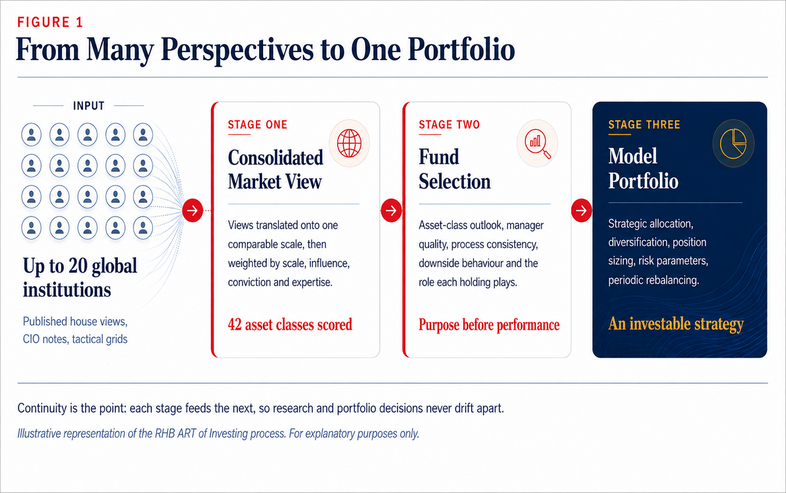
Figure 1 · The three connected stages of the ART of Investing methodology. Research does not stop at commentary; it progresses through to implementation.
Source: RHB Bank July 2026
Inside the framework: how the view is built
The methodology becomes more concrete when you look at the discipline behind RHB's quarterly investment outlook; the document in which the consolidated view is formally recorded each quarter.
It begins with a defined universe. The published positioning of a panel of major global asset managers is assembled — houses that between them oversee a very substantial share of the world's professionally managed capital. The panel deliberately mixes global index giants, active equity specialists, dedicated fixed income houses and private-banking chief investment offices, on the reasoning that a panel drawn too narrowly would simply reproduce a single style of thinking at greater length.
Their views are then mapped onto a common analytical scale, so that a European multi-asset house and an American bond specialist can be compared on the same terms. This translation step matters more than it sounds. House views are published in incompatible formats; some as precise tactical grids, others as narrative essays, and without a common scale.
Source Discipline
- The rule: only publications within the current quarter's window are eligible. A view published one quarter earlier, however elegantly argued, is excluded rather than carried forward.
- Why it matters: it prevents a stale conviction from lending false weight to a current reading — a subtle but common failing in aggregated research.
- The consequence: where a house has not published recently, it is recorded as absent rather than assumed. Coverage gaps are disclosed, not filled by inference.
Filtering out the noise
Every investment house publishes research differently. Some focus on equities; others specialize in fixed income, commodities or regional markets. Their reports vary in style, depth and frequency, and digesting all of it manually would be a herculean task.
The AI engine ingests, categorizes and scores hundreds of published observations across dozens of asset classes. By applying a consistent standard to every source, it identifies areas of consensus, divergence and conviction far more efficiently than a traditional research process — assessing in hours what might take weeks to compile by hand, so insights stay fresh while conditions are still evolving. It also removes a very human tendency: to give extra credence to the institution one happens to admire most.
Importantly, ART is not a simple average of opinions. Each institution's contribution is weighted, not merely tallied, on the reasoning that not every credible voice carries equal consequence for the market, or equal analytical commitment.
Not every voice carries equal weight
Each view is weighted according to four considerations.
- The first is scale: when a manager overseeing larger assets repositions, market prices tend to respond, so market significance may shape the relevance of a view. A cap is applied so that no single institution can dominate the output; breadth is the objective, and a framework overwhelmed by one voice would defeat its own purpose.
- The second is influence: certain houses shape market debate well beyond the size of their asset base, and that narrative authority has real consequences for positioning.
- The third is conviction: an institution publishing an explicit, specific position committed to something and is weighted more heavily than one offering general observations; vagueness, in this framework, is quietly penalized.
- The fourth is domain expertise: a house with a distinguished fixed income franchise carries greater weight when the question concerns bonds; a recognized commodities desk carries more when the subject is gold. Authority, sensibly understood, is specific rather than general.
The effect is a weighted reading rather than a simple tally — one that reflects relevance, context and strength of evidence. The process is judgment-led and non-mechanical, and it remains subject to periodic review.
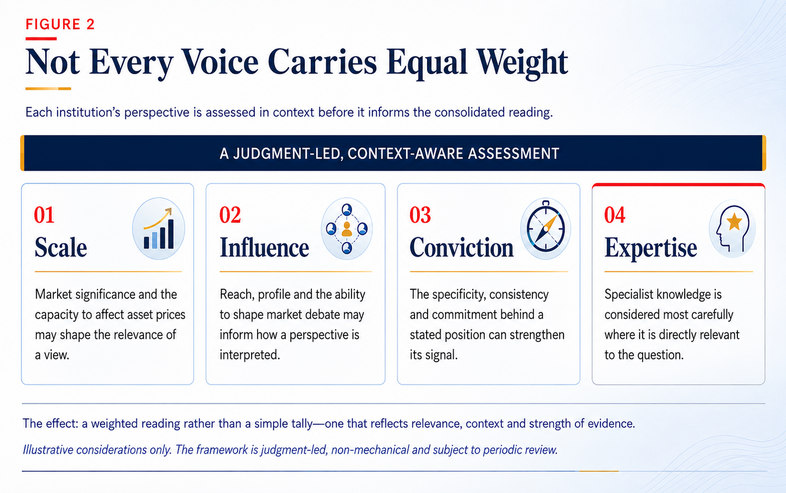
Figure 2 · The four weighting considerations applied to each institution's view before it enters the consolidated reading.
Source: RHB Bank July 2026
While much of this sounds automated, technology is only one part of the equation. Investment decisions should never be reduced to an algorithm alone. Experienced human professionals provide oversight, context and judgement, ensuring the information is interpreted thoughtfully and applied reasonably. AI does the heavy lifting; human experts make the final call.
From insight to implementation: how funds are selected
A market view, however well formed, is not yet investable. The next stage turns that view into specific fund ideas — the point where analysis becomes selection.
What tells us most about a fund is its long-term record. Strong performance sustained over many years is the clearest evidence of a manager's skill: proof that a team can do what the fund was built to do, whether that is to grow capital, generate income or steady a portfolio, through changing conditions.
To keep that judgement consistent, each fund is scored rather than assessed by impression. Every quarter, every eligible fund is ranked against its peers on three simple questions: how well it has performed, how much risk it took to get there, and how efficiently it turned that risk into return. The three combine into a single, comparable score.
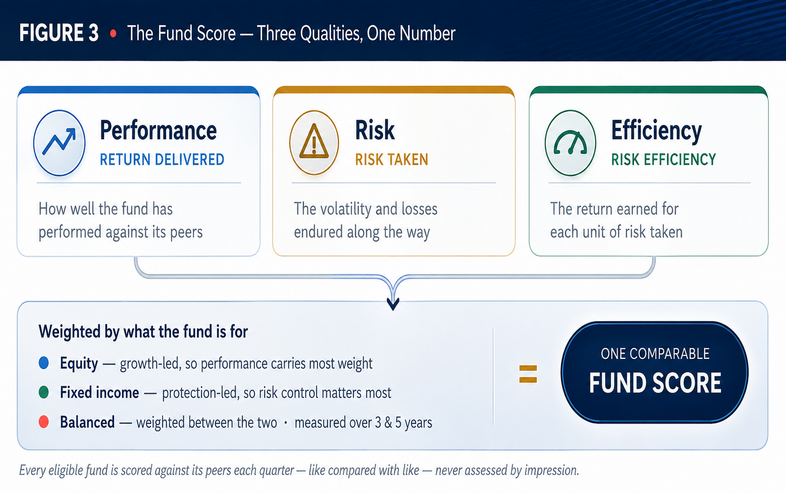
Figure 3 · Performance, risk, and efficiency combine into one comparable fund score — weighted according to what each fund is designed to do.
Source: RHB Bank July 2026
The weighting reflects what the fund is for. An equity fund exists to grow, so performance counts for most; a fixed income fund exists to protect, so risk control counts for most; a balanced fund sits in between. Each is judged by the standard that fits its job, not one yardstick applied to everything. The score is then taken over both three and five years, with the three-year view showing how a fund handled the recent cycle, and the five-year view indicating whether that strength lasts.
The score narrows the field, but it does not decide it. The consolidated market view from the first stage, together with the fund's score and the standing of its management team, determines which funds are ultimately carried forward. The numbers find the capable funds; professional judgement, guided by the wider outlook, chooses among them. This is where the two stages meet.
Where ideas become architecture: building the portfolio
The final stage is where views become strategy. Selected ideas are assembled into model portfolios, each built around defined objectives, a specific risk profile and prevailing market conditions.
This is the stage most often underestimated. A portfolio is not simply a collection of strong individual investments. Architecture offers the clearer analogy: a building is not the sum of its finest materials. Excellent components, assembled without structural intent, produce something unstable. Portfolios behave the same way — individually attractive holdings can disappoint collectively, through unintended concentration, through correlated risks that surface only under stress, or through position sizes bearing no relation to conviction. Structure is what turns good ideas into a strategy.
Model portfolio construction addresses this directly, through strategic asset allocation, diversification across asset classes and geographies, considered position sizing and clearly defined risk parameters. It also establishes a rhythm of periodic review and rebalancing — which, in practice, is what allows an investor to stay disciplined when volatility invites them not to be. Every allocation carries a stated purpose, and the portfolio retains its coherence as conditions evolve.
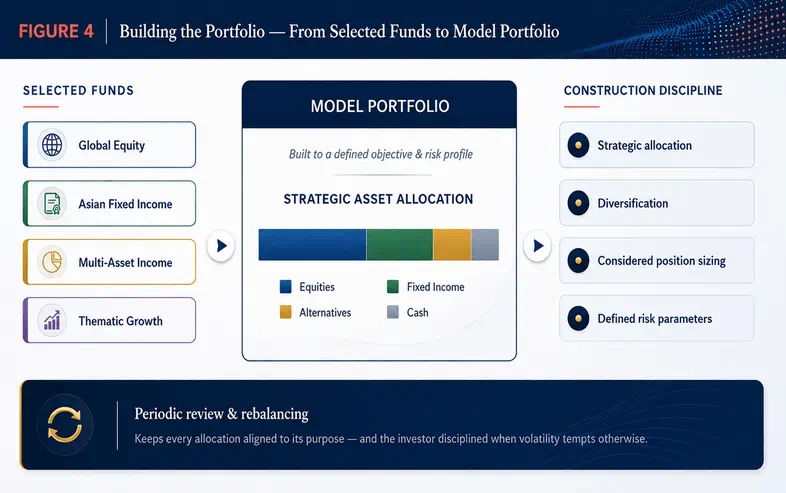
Figure 4 · Selected funds are assembled into a model portfolio built to a defined objective and risk profile, then reviewed and rebalanced over time.
Source: RHB Bank July 2026
The result is a direct line from research to implementation — a broad, weighted market view, translated into rigorously selected funds, assembled into a portfolio built to a clear and deliberate design. Continuity is the point: each stage feeds the next, so research and portfolio decisions never drift apart.
Where technology ends and judgement begins
It is worth being precise about what the technology does and does not do. AI makes the methodology practical: it allows the systematic processing of a volume of research that would otherwise be prohibitive, and it applies the same analytical standard to every source. What it does not do is predict markets or remove risk. No analytical system can. Its value is speed, breadth and consistency — not prophecy.
That consistency carries a further, understated benefit. Because the same framework is applied every quarter, the output is comparable over time. An investor can see not merely what the consolidated view is today, but how it has changed — and a shift in professional conviction is often more informative than the level of conviction itself.
Judgement, though, remains unmistakably human.
Investment professionals interpret context no dataset fully captures, challenge conclusions that look too neat, assess whether a recommendation genuinely suits a client's circumstances, and decide when a framework's output should be overridden rather than followed. Technology sharpens the analysis; people remain accountable for the advice.
Why multiple perspectives matter
Markets are complex because the world is complex. Growth, inflation, interest rates, geopolitics, corporate earnings and investor sentiment all interact in ways that are often unpredictable, and at speed. Individual research houses inevitably reflect their own philosophy, client base and positioning; while each perspective may be well-founded, none captures the market in its entirety. A synthesized view helps distinguish broad institutional consensus from isolated conviction.
Equally important, it introduces consistency and transparency into the research process. Rather than reacting to the latest headline or chasing every prediction, an investor can anchor decisions within a disciplined framework, and that discipline is most valuable precisely when markets are least calm. When volatility strikes, emotions can become an investor's worst enemy; fear and greed lead to rushed decisions, poor timing and unnecessary portfolio changes. A structured process helps reduce the temptation to react impulsively to short-term noise.
The discipline of the long voyage
The experienced navigator does not attempt to predict the weather for an entire crossing. Conditions will change, and no preparation prevents that. What preparation provides is more durable — instruments that stay reliable when visibility fails, a route considered in advance rather than improvised under pressure, and the discipline to adjust course deliberately rather than react to every shift in the wind.
Wealth is built and preserved on much the same principle. The most consequential decisions are rarely dramatic; they are the accumulated result of a process applied consistently, through cycles that reward patience and cycles that test it. The RHB ART of Investing was developed in that spirit. It does not offer certainty, and does not claim to. What it offers is a broader field of view, a structured means of translating that view into decisions, and the continuity between research and portfolio that lets an investor act with conviction rather than merely confidence.
In markets, as in any disciplined pursuit of excellence, the advantage rarely lies in knowing more than everyone else. It lies in deciding better, more consistently, over a longer period of time. To find out how the RHB ART of Investing framework applies to your portfolio, speak with your RHB Premier Relationship Manager for a personalized review.